Internship at Magna International, Advanced Robotics R&D
Dual-arm assembly R&D: from CAD to a learned insert
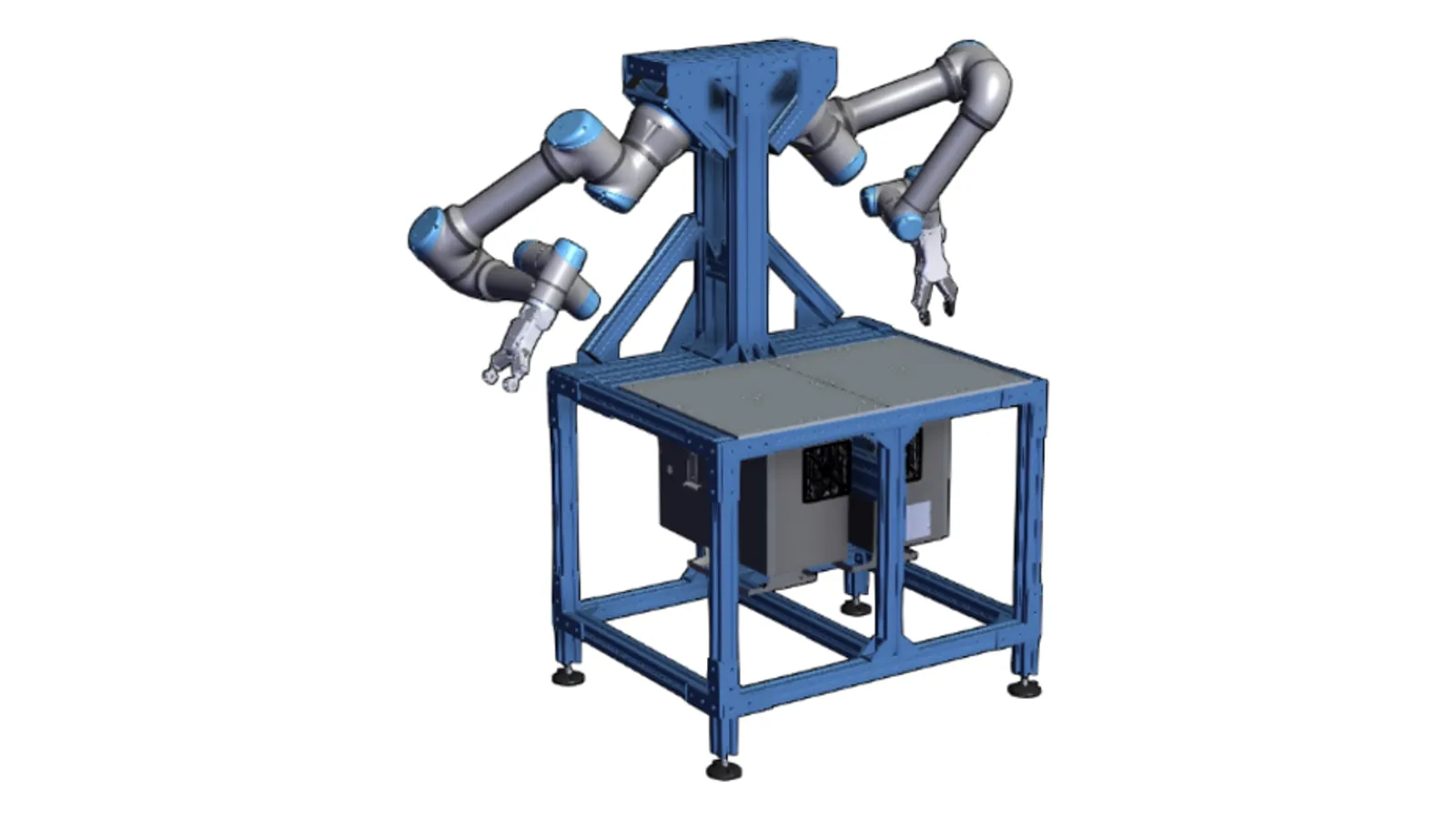
Research and development internship at Magna. A dual-arm pipeline in Isaac Sim that plans a full production assembly in 59 seconds, then hands the last millimeters of insertion to a learned policy.
Abstract
Research internship at Magna Advanced Robotics. I built a dual-arm pipeline in Isaac Sim that takes production CAD models and plans a full robotic assembly in just 59 seconds. Classical geometry handles the gross movements, but provably fails on the final millimeter of insertion due to physical interference. To solve this, a machine learning policy takes over for the last few centimeters, seamlessly integrated into a single execution task.
Introduction
Geometric path planning solves how a robot moves through free space. It completely fails when parts actually touch. Three observations drove this project:
- Physics matters. A trajectory that passes every collision check can still jam under physical grasping constraints because the planner lacks a contact model.
- Micro-tolerances. One part could not be inserted at all using classical planning. A residual tilt of just 2.2 degrees caused the arm to press to 300 Newtons without seating.
- Interference fits. Another component seats through roughly a millimeter of actual physical interference. This is a corridor narrower than the inherent positional scatter of any AI policy trying to learn it.
The architecture is built around this boundary: everything before contact stays classical, and machine learning is only spent on the final insertion.
The pipeline
- Geometric planning. The assembly planner searches for extraction paths using pure geometry. Threaded and press-fit parts require screw motions to unbind.Rotating while sliding unbinds what pure sliding binds.
- Task expansion. The task planner expands the high-level order of work into 31 distinct segments, statically validating them in under a second without running the physics simulator.
- Data generation. The physics replay serves as both a plan checker and a dataset recorder. Every recorded demonstration is guaranteed to be an executable path.
- Drop-in learning. A trained policy is not a separate script. It runs as a standard pipeline operator, meaning a single config change swaps a classical insertion for a learned one.
Planning results
| Metric | Performance |
|---|---|
| Segments planned | 31 of 31 |
| Full assembly time | 59.24 s (1.31 s variance across runs) |
| Median segment time | 1.32 s |
| Speedup | 4.4x faster than the previous engine |
- Coordinated movement. The dual-arm carry is the most expensive operation, taking up 24% of the time despite being less than 10% of the plan.
- Cost drivers. Execution time is driven by physical path length, not the planning mode.
- Seamless integration. Routing the final insertion through a learned policy cost no more execution time than the classical equivalent.
Learned skills results
Instead of human teleoperation, a privileged expert script combined with the planner generated exactly 150 successful demonstrations (mean seat error 1.005 mm) under full randomization.
- Reinforcement learning. Achieved a 60% success rate at 9.7 N median peak force, beating a scripted baseline (71% success, but a massive 47 N peak force). Success depended heavily on curating the demonstrations, not the algorithm.
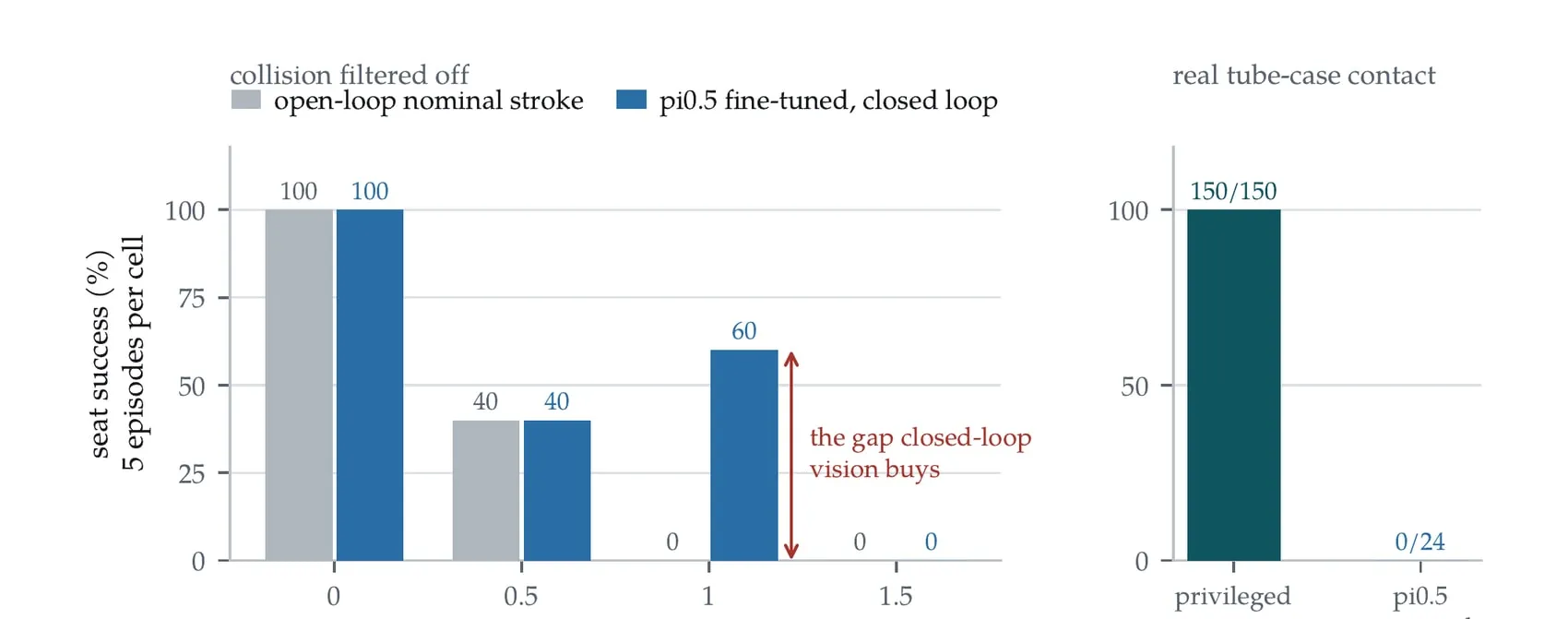
- Vision-Language-Action (VLA). Closed-loop vision successfully seated parts where open-loop movements failed (3 of 5 success rate). However, when retrained with real physical contact data, success dropped to zero because the policy's positional scatter was wider than the physical clearance corridor.
- Residual models. 11 of 11 parts seated perfectly when the exact mathematical correction was explicitly supplied. But when left to learn the correction across four models, it achieved 0 of 436. Proprioception alone cannot "see" the tiny errors the residual is meant to fix.
Limits and next steps
- Hardware bottleneck. Training throughput is severely capped by having only one GPU and one simulation environment.
- Memory constraints. The residual model desperately needs visual input to succeed, but the frozen base model and the simulator leave no VRAM left for a vision encoder.
- Sim-to-real gap. The force-feedback teleoperation track remains an analysis project. Nothing has been deployed to physical hardware yet.